
UPS systems in the defense sector
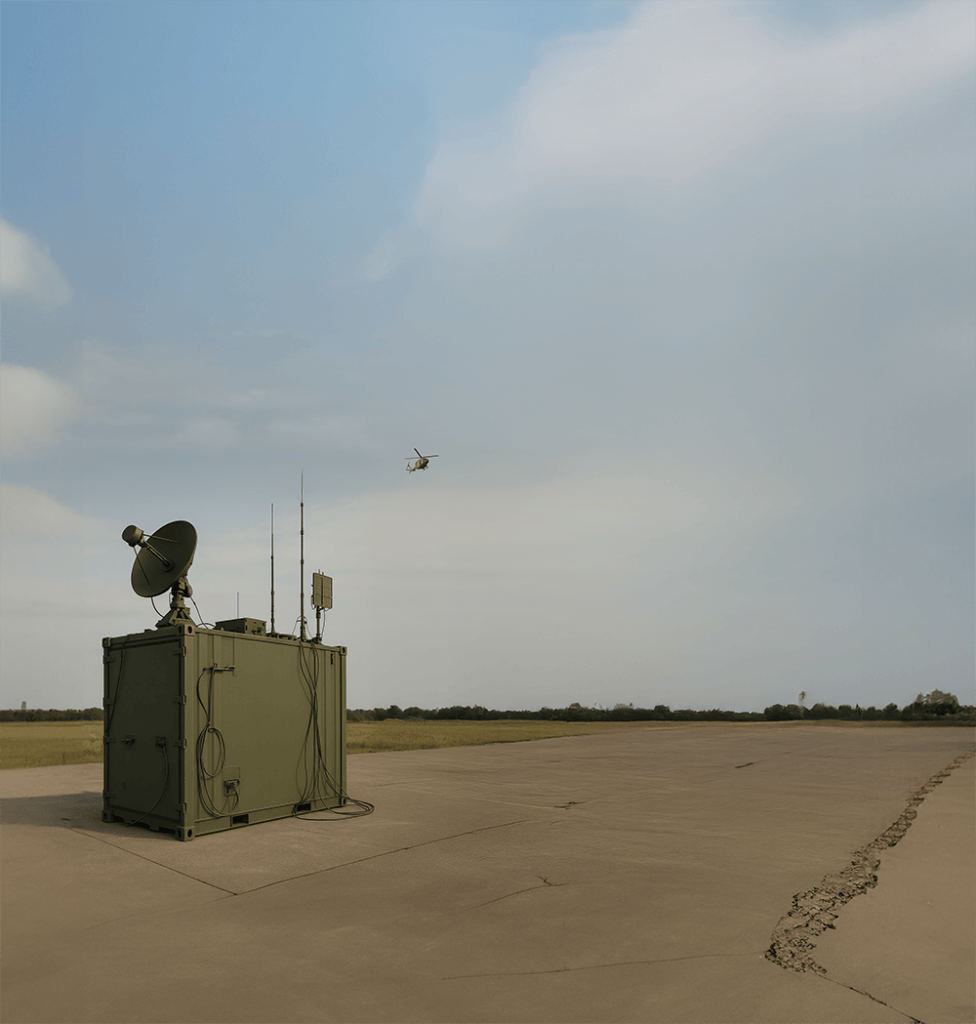
Security of supply is of central importance in the defense sector.
UPS systems guarantee a reliable power supply for safety-critical systems and ensure maximum availability, even under extreme conditions.
Energy and defense: sustainability meets security of supply
The link between energy and defense encompasses two central fields of action: the energy autonomy of modern armed forces and the safeguarding of critical energy infrastructure. The German Armed Forces are consistently driving forward the expansion of renewable energies in their facilities and are striving to achieve a complete supply of green electricity, while the USA is increasingly relying on self-sufficient microgrids and nuclear energy in order to reduce strategic dependencies. At the same time, the EU and NATO are pursuing „Green Defense“ approaches with the aim of making defence structures more sustainable. The European Defense Agency and NATO, among others, are promoting corresponding climate strategies that combine ecological responsibility with operational readiness.
What is Green Defense?
NATO's Green Defense approach emerged from the missions in Afghanistan and Iraq, where fuel supplies became apparent as a central weak point in military operations.
At its core, Green Defense aims above all to increase the energy security of the armed forces: Dependencies on external or unstable energy sources are to be reduced and local, resilient supply structures that function reliably even in the event of disruptions are to be established instead.
Aspects such as sustainability or climate change are taken into account, but are not the main focus. Green Defense is therefore primarily a security-driven approach that strengthens military operational capability through a robust, more autonomous energy supply.
UPS systems make a significant contribution to this by supplying critical systems without interruption in the event of power failures or voltage fluctuations, stabilizing energy flows and thus directly increasing the operational resilience of modern defence infrastructures.
Importance of the uninterruptible power supply
Uninterruptible power supply systems, or UPS systems for short, play a central role in the defense sector. Modern armed forces and security-critical organizations are highly dependent on stable electrical power. Command centers, communication networks, data centers, radar and sensor systems as well as mobile units require a continuous power supply, as even brief interruptions can have serious operational consequences.
UPS systems ensure that these systems continue to operate reliably even in the event of power failures, voltage fluctuations or transient faults. They seamlessly bridge power interruptions, stabilize the power quality and protect sensitive electronics from damage. At the same time, they enable a controlled transition to emergency power generators or other energy sources and prevent data loss and system crashes.
Military-specific requirements for UPS systems
In the military environment, UPS systems differ significantly from classic industrial or office applications. In addition to high electrical performance, defense UPS systems must be designed to be particularly robust. They are often operated in harsh environments and must be able to reliably withstand extreme temperatures, vibrations, shocks, dust, moisture and electromagnetic influences.
Accordingly, specially hardened components are used that are tested in accordance with military standards. Increased electromagnetic compatibility and additional safety functions are also typical requirements.
Wöhrle Stromversorgungssysteme GmbH meets military UPS requirements with customized energy solutions instead of standard products. Based on its own UPS systems, Wöhrle realizes robust industrial platforms with vibration and shock-resistant construction, extended temperature ranges and adapted dust and moisture protection. These are supplemented by redundancy concepts (N+1/2N), high-performance battery systems, integrated monitoring and load prioritization for maximum availability. EMC-optimized enclosure architectures, filter and earthing concepts ensure interference immunity, while project-specific tests based on military standards ensure suitability for use.
Availability through redundancy and modularity
Another key feature is redundancy. In many military applications, UPS systems have a modular structure and are designed in N+1 or even multiple redundant configurations. This means that the power supply is guaranteed even if individual modules fail or require maintenance. This architecture significantly increases availability and is indispensable for mission-critical systems in particular.
Wöhrle Stromversorgungssysteme GmbH meets these redundancy requirements with modular UPS architectures with an N+1 or 2N design. Power and battery modules are connected in parallel and are hot-swappable so that individual modules can fail or be serviced during operation without interrupting the supply. Redundancy modules and decoupling diodes ensure that the power supply units are physically separated so that a fault in one branch does not jeopardize the entire system. Buffer capacitors cover high starting currents (e.g. when starting motors or valves) without the DC output voltage collapsing. The scalable systems range from 5 A to 1,000 A, depending on the design and application.
Typical areas of application in the defense sector
Typical areas of application for UPS systems in the defense sector are stationary command and situation centers, tactical data centers, communication and encryption systems, radar drones and surveillance systems as well as military research and testing facilities.
In addition, mobile and container-based UPS solutions are increasingly being used, for example for field camps or temporary bases. In this context, compact designs and high energy densities are becoming increasingly important.
Wöhrle Stromversorgungssysteme GmbH meets these operational requirements with flexible, modular UPS systems that are designed for both stationary and mobile applications. For command and situation centers, tactical data centers, communication and sensor systems, Wöhrle supplies scalable UPS architectures with high power density, integrated battery support and continuous monitoring. Compact, container-capable solutions with increased energy density that can be quickly relocated and expanded are realized for field camps and temporary bases of operations. Through project-related engineering, the design, performance, self-sufficiency time and redundancy are precisely tailored to the respective area of application; from fixed facilities to mobile platforms. Suitable storage technologies are also integrated for demanding environments such as deserts, high altitudes, dust exposure or high humidity. Depending on the application, lithium or lead-gel batteries are used. Pure lead batteries such as Hawker Enersys CYCLON are characterized by high cycle stability and robustness. In combination with an active battery management system (BMS), application ranges from -40 °C to over +80 °C can be realized, making the solutions particularly suitable for defence and marine applications as well as mobile container solutions in climatically difficult zones.
Technological development and future trends
As the digitalization of the armed forces progresses, the importance of a secure energy infrastructure is also increasing. Networked systems, cloud-based evaluations, AI-supported analysis platforms and autonomous components are further increasing the need for a reliable power supply.
Wöhrle Stromversorgungssysteme GmbH is already technologically well prepared for these developments. Today, Wöhrle offers modular UPS systems with high power density, integrated monitoring and scalable battery platforms that are suitable for networked IT infrastructures, data-intensive applications and automated systems. Redundancy, autonomy times and power distribution are specifically designed for digitalized application scenarios through project-related engineering. A graduated concept is available for the design of autonomy times: Short-term backups (milliseconds to minutes) can be covered by buffer capacitors or ultra-caps, medium autonomy times (1 to 8 hours) are typical for communication and control tasks, and long-term autonomy (24 to 72 hours or more) is realized in off-grid scenarios such as island operation, remote deployments or defence projects without fast service access.
Wöhrle already supports the requirements of modern defense architectures, from networked command centers to mobile platforms, and creates the basis for future applications such as AI-supported evaluation and autonomous systems through scalable, highly available energy infrastructure. Especially in modern control technology, the fail-safe DC power supply is the „central nervous system“: even very short voltage dips can cause PLC controls to crash, cause data loss or cause contactors to drop out uncontrollably. A stable energy and safety architecture prevents these consequences and keeps critical processes under control.
Advantages of military-grade UPS systems
Military-grade UPS systems offer a number of key advantages:
Continuous power supply
UPS systems ensure an uninterruptible power supply in the event of failures or voltage fluctuations, thereby safeguarding mission-critical military operations.
Avoidance of data loss
Sensitive and confidential data remains protected, as systems can continue to operate or be shut down in a controlled manner.
Device protection
Overvoltages, voltage peaks and fluctuations are balanced out, protecting sensitive equipment and extending its service life.
Cost savings
Avoiding equipment damage and downtime reduces maintenance and operating costs in the long term.
Increased security
Communication networks, perimeter defense and surveillance remain functional even during power outages.
Technical role of UPS systems from Wöhrle Stromversorgungssysteme GmbH
Modern drone defense systems are based on a distributed real-time architecture consisting of sensor nodes (radar, RF scanners, EO/IR), effectors (e.g. high-performance jammers) and central command and evaluation platforms. These subsystems are linked via IP-based networks, time references and control buses and are highly sensitive to voltage deviations, frequency instabilities and transient network effects.
UPS systems from Wöhrle are used in such architectures as the primary power conditioning and backup level. They provide galvanic decoupling from the supply network, stabilize the output voltage (AVR), filter harmonics and bridge power failures in the millisecond range without interruption. This maintains the real-time processing of the sensor fusion and the continuous data connection of the effectors.
At sensor level, decentralized DC or AC UPS modules ensure the continuous supply of radar frontends, RF receivers and EO/IR camera heads. This prevents reboots, calibration losses and synchronization errors, which would otherwise lead to blind times in the detection chain. At the same time, powerful UPS units supply the control stations, server clusters and AI-supported evaluation platforms and guarantee constant operating conditions for GPU-based image and signal processing.
A key technical feature is the control of high load dynamics. Jammers and active sensors generate short-term power peaks with steep current increases. The UPS systems from Wöhrle are designed for this with fast control circuits, high overload capacity and sufficiently dimensioned energy storage units so that peak loads are intercepted without causing voltage dips or protective shutdowns.
In distributed counter UAS installations, UPS concepts are typically structured hierarchically and redundantly: local UPS nodes on sensor masts and effectors, supplemented by central UPS strings in control containers or computing modules. Single points of failure can be eliminated using modular N+1 topologies. If a power module fails, the remaining modules seamlessly take over the supply, while maintenance remains possible during operation.
For mobile and temporary application scenarios, such as containerized systems, vehicles or advanced sensor points, robust UPS units also ensure the buffering of unstable power supplies from generators or hybrid energy sources.
In summary, UPS systems from Wöhrle form the energy stabilization layer of modern drone defence systems. They ensure constant supply parameters for sensors, data processing and effectors, compensate for load jumps, prevent synchronization losses in distributed architectures and ensure the required high availability through modular redundancy. This makes them an integral part of the system reliability and operational effectiveness of counter-UAS platforms.